
How to choose stainless steel spheres correctly?
The stainless steel sphere can be tightly closed with only a 90 degree rotation and a small rotational torque. The completely equal valve body cavity provides a low resistance, straight through flow channel for the medium. The main characteristics of a ball valve are its compact structure, easy operation and maintenance. Stainless steel ball valves can be used to control the flow of various types of fluids such as air, water, steam, various corrosive media, mud, oil, liquid metal, and radioactive media. The valve body of a ball valve can be integral or modular. This type of valve should generally be installed horizontally in pipelines. Classification of stainless steel ball valves: stainless steel pneumatic ball valves, stainless steel electric ball valves, stainless steel manual ball valves. The material of stainless steel ball valves is divided into 304, 316, 321 stainless steel ball valves.
Classification selection:
(1)Ball valves can be divided into floating ball valves according to their structural form: the ball of a ball valve is floating, and under the pressure of the medium, the ball can produce a certain displacement and be tightly pressed against the sealing surface at the outlet end, ensuring the sealing of the outlet end. The structure of a floating ball valve is simple and has good sealing performance, but the ball bears all the load of the working medium and is transmitted to the outlet sealing ring. Therefore, it is necessary to consider whether the sealing ring material can withstand the working load of the ball medium. This structure is widely used for medium and low pressure ball valves.
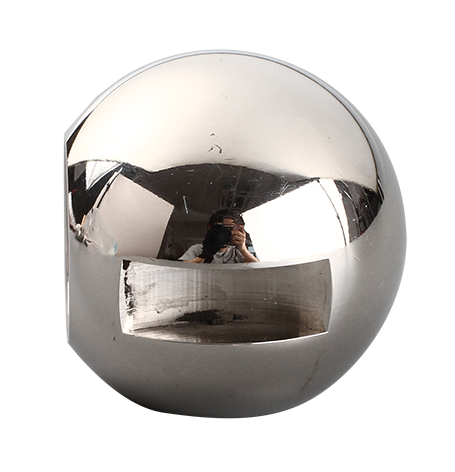
(2)Ball valves can be divided into straight through, three-way, and right angle types according to their channel positions. There are T-shaped and L-shaped three-way ball valves. T-shaped can connect three orthogonal pipelines and cut off the third channel, playing a role in diversion and merging. L-type can only connect two pipes that are orthogonal to each other, and cannot maintain the interconnection of the third pipe at the same time. It only plays a role in distribution.
The three-way ball valve adopts an integrated structure in terms of structure,
The sealing type of the face valve seat has few flange connections, high reliability, and is designed to achieve lightweight
The three-way ball core is divided into T-shaped and L-shaped, with a long service life, high flow capacity, and low resistance
Ball valves are divided into two types: single acting and double acting. The characteristic of single acting is that once the power source fails, the ball valve will be in the state required by the control system.
(3)Ball valves can be divided into one piece, two piece, and three piece according to their composition.
Fixed ball valve: The ball of the ball valve is fixed and does not move under pressure. Fixed ball valves are equipped with floating seats, which move when subjected to medium pressure, causing the sealing ring to press tightly against the ball to ensure sealing. Usually, bearings are installed on the upper and lower shafts of the sphere, with a small operating torque, suitable for high-pressure and large-diameter valves. In order to reduce the operating torque of ball valves and increase the reliability of sealing, oil sealed ball valves have emerged. They inject special lubricating oil between the sealing surfaces to form a layer of oil film, which enhances sealing performance and reduces operating torque, making them more suitable for high-pressure and large-diameter ball valves.
The ball and valve seat sealing ring are both made of metal materials, and the sealing pressure ratio is very high. Relying on the pressure of the medium itself cannot meet the sealing requirements, and external force must be applied. This type of valve is suitable for high temperature and high pressure media. An elastic sphere is obtained by creating an elastic groove at the lower end of its inner wall. When closing the channel, use the wedge-shaped head of the valve stem to expand the ball and press it against the valve seat to achieve sealing. Release the wedge-shaped head before rotating the sphere, and the sphere will return to its original shape, creating a small gap between the sphere and the valve seat, which can reduce friction and operating torque on the sealing surface.